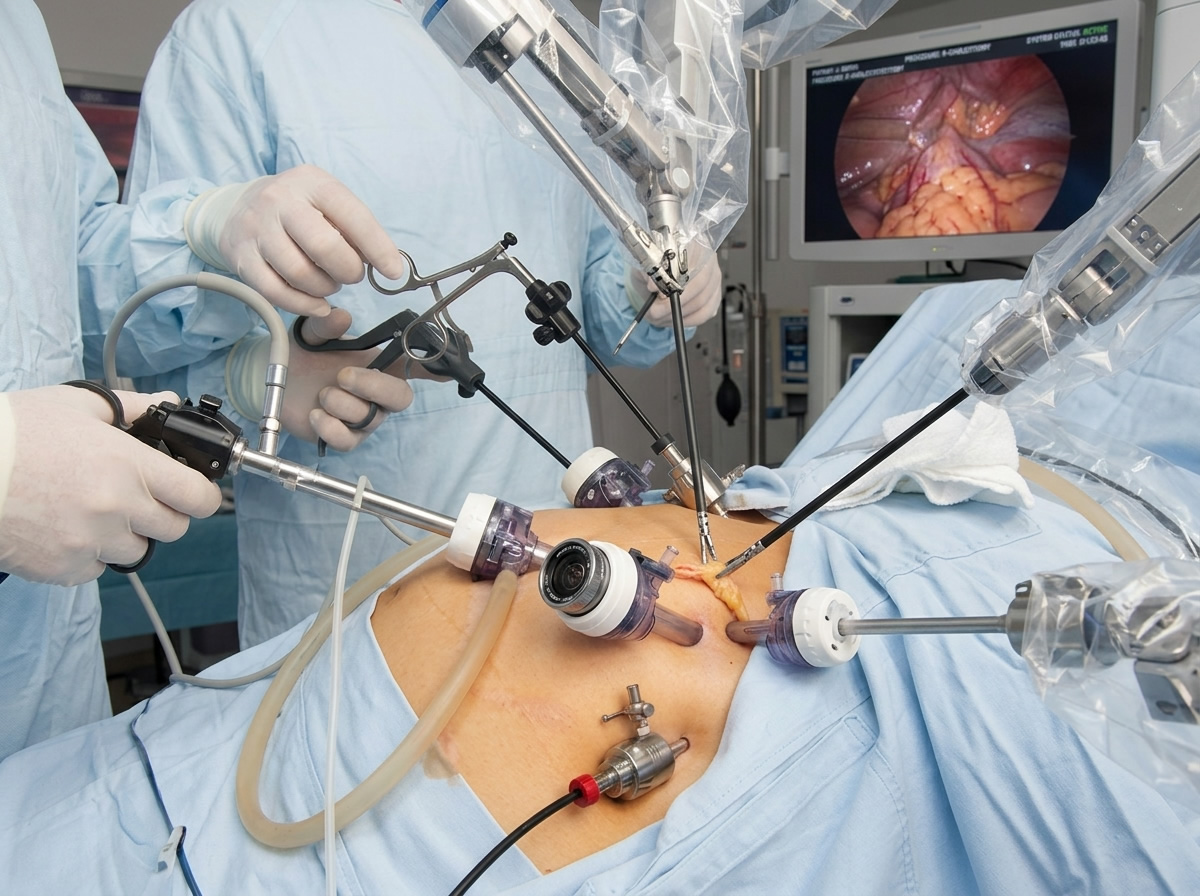
In the evolution of abdominal surgery, the transition from open to minimally invasive techniques has been one of the most significant shifts in patient care. As an HPB surgeon, I regularly use both robotic and advanced laparoscopic techniques. This has led to a recurring discussion with surgical trainees: Is manual laparoscopic suturing a necessary core competency, or is it a technique being superseded by newer technology?
In my view, manual laparoscopic suturing is an essential skill for any surgeon performing abdominal procedures. It can sometimes determine whether a surgeon can complete a procedure laparoscopically or whether they must convert to an open incision.
The Curriculum and Skill Acquisition
The Royal Australasian College of Surgeons (RACS) curriculum outlines broad competencies in “Technical Expertise” and procedural safety. However, intracorporeal laparoscopic suturing is rarely defined as a discrete, mandatory benchmark.
In practice, training often occurs through “opportunity-based” learning. A trainee’s proficiency frequently depends on their specific hospital rotation and the availability of senior supervision. This lack of a standardized, formal requirement can create a gap between general surgical training and the requirements of advanced abdominal practice. We often teach the tools of laparoscopy, but we do not always provide the structured environment necessary to master the intricate task of suturing within the abdomen.
Why Suturing Proficiency Expands Minimally Invasive Options
The ability to suture laparoscopically directly influences the scope of a surgeon’s practice. When a surgeon masters this skill, they increase their ability to manage complex cases without opening the abdomen. The relevance of this skill in abdominal surgery includes:
- Expanding the Reach of Laparoscopy: Many complex tasks, such as repairing a bile duct injury, performing a laparoscopic hepaticojejunostomy, or securing a difficult vessel, require suturing. If a surgeon lacks this ability, these procedures are either converted to open surgery or become unavailable laparoscopically. Some relatively straightforward operations like patching a peptic ulcer may still be done open only because the surgeon is unable to suture laparoscopically (there are other valid indications for open surgery).
- Managing Intraoperative Complications: Abdominal surgery carries the risk of unforeseen vascular or bowel injuries. The ability to perform a precise, intracorporeal suture can be the difference between resolving a complication laparoscopically and having to abandon the approach. It acts as an autonomous safety measure.
- Precision in Tissue Handling: Laparoscopic suturing requires careful manipulation of tissue without the assistance of wristed robotic instrumentation. This practice forces a surgeon to understand the mechanical limits of tissue—a form of tactile feedback that is essential for all forms of surgery, whether open, laparoscopic, or robotic.
- Efficiency and Flow: Mastering the mechanics of the needle driver and the knot-tying process—whether using extracorporeal or intracorporeal techniques—allows the surgeon to move through the procedure with greater control. It reduces the need for reliance on specialized clips or stapling devices, which may not always be the optimal choice for a specific anatomical repair.
The Verdict
Manual laparoscopic suturing should be regarded as a foundational skill rather than an elective technique. While robotic surgery is an excellent tool, it is not a substitute for the fundamental ability to repair tissues manually using a laparoscope.
To ensure our surgical standards remain high, we should prioritize structured simulation and supervised practice early in training. Mastering the stitch makes a surgeon more versatile, more capable of managing complications, and ultimately better equipped to provide the benefits of minimally invasive surgery to a wider range of patients. A surgeon who was unable to suture in open surgery would be considered technically deficient to the point of being a non-starter. As MIS techniques become more ubiquitous, we should aspire to a similar standard in laparoscopy.